
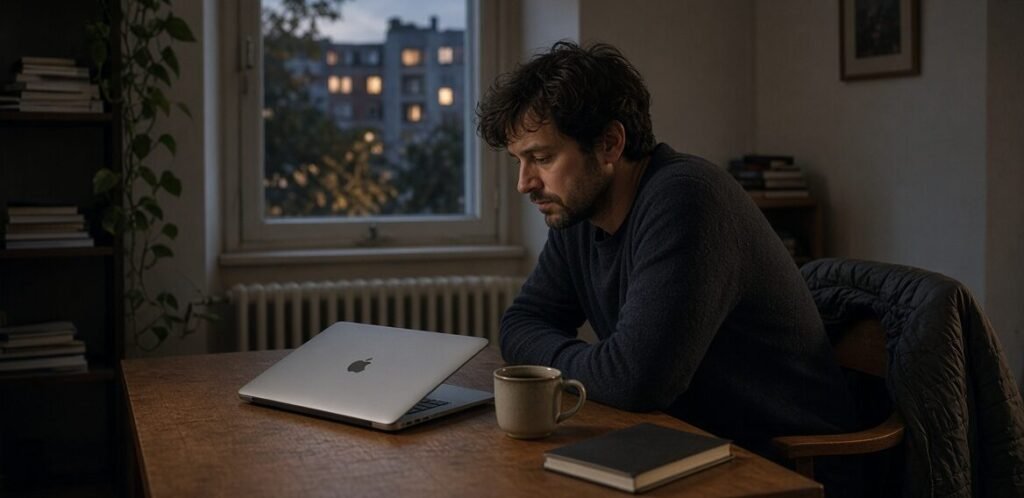
When the afterglow fades…
You open the laptop at the desk while the city lights come on, and the only move that feels available is to get the glow back — even though the glow was never the change.
What to Do After the Afterglow Fades?
When the afterglow fades, most people try to get the feeling back by sitting at the desk in the evening with the laptop open or half-closed, the cup still on the table from earlier in the day and the city lights coming on outside the window, while the amplified openness that was present for the first days after the experience has already quieted and ordinary light has returned. The temptation is to keep the laptop open longer, to search for another date or to increase practices until something resembling the earlier state reappears.
If you want to see where you are in the process, the free orientative tool is here.
The afterglow is not the change itself. It is the temporary report that a change is still new. Elevated openness, reduced threat weighting and a temporary shift in how ordinary moments feel are real while they last, yet they are also time-limited. When the report quiets, what was lived during the experience remains available if there is a way to hold it. Most people lose contact with it at this point because they have only been taught to track the signal. When the signal drops they conclude that the process has ended, leaving the system with no further instruction for how to stay with what already moved once the desk, the cup and the evening light have returned to their previous condition.
Without knowing where you are in the process the fade is read as failure or as proof that nothing substantial occurred. The search for the next glow begins before any holding has taken place. Another experience is scheduled. Another technique is added. Each time the temporary report returns the underlying gap remains the same: there is still no container for the period after the signal has gone quiet. Over repeated cycles the pattern becomes familiar. Insights arrive. The feeling fades. Nothing appears to stick once ordinary evenings resume.
There is a way to hold what was lived after the signal drops, and it begins with seeing where you are in the process so that the next step matches what the system actually needs rather than another attempt to restart the feeling. Orientation allows the quiet at the desk to be read as part of the timeline instead of as evidence that the work has already been lost. When the location is clear the evening light and the closed laptop no longer have to function as the end of what the experience opened. The cup stays on the table, the buildings stay outside the window, and the work of holding continues without requiring the amplified report to return.
The ordinary evening becomes the place where what was lived is either abandoned or kept. What remains available does not depend on the temporary report returning; it depends on knowing where the system is and what it needs once the signal has gone quiet, the desk and the evening light stay exactly where they were, yet the capacity to remain in contact with what moved no longer requires the amplified openness to reappear.
The quiet that arrives at the desk is not the loss of what was lived; it is the interval in which holding either continues or is left unfinished.
If you want to see where you are in the process, the free orientative tool is here.